



← Periodontics & dental implants at Sage Dental Specialists
[Last updated: 26 August 2026]
Can a Tooth with Bone Loss Be Saved? How the Decision Is Made
Key takeaways:
-
A tooth with bone loss can often still be saved, depending on the remaining bone support, severity and pattern of bone loss, gum health, and whether the tooth can be maintained long term
-
Treatment for bone loss around teeth may include non-surgical periodontal treatment, regenerative periodontal surgery, resective surgery, or splinting, depending on the condition of the tooth
-
Tooth extraction may be recommended when a tooth has a poor long-term prognosis, such as severe bone loss, persistent mobility, repeated infection, or difficulty keeping the area clean
So, can a tooth that has bone loss be saved? Often, yes.
Bone that has been lost because of gum disease does not usually grow back on its own. However, bone loss does not automatically mean that a tooth has to be removed.
The important question is whether the tooth still has enough support, whether the gum disease can be brought under control, and whether the tooth can be kept clean and healthy in the long term.
This is why the decision is made tooth by tooth, based on a detailed periodontal examination, measurements and dental imaging.
What determines whether a tooth can be saved?
There are several important factors to consider.
1. How much bone support is left?
Teeth are held in place by the bone and surrounding tissues. The more bone that has been lost, the less support the tooth has.
However, the amount of bone loss is only part of the picture. A tooth that has lost one-third of its support is very different from one that has lost three-quarters of its support, even if both may look similar in the mouth.
2. What is the extent and severity of bone loss around that tooth?
This is an important distinction that patients are often not aware of.
Sometimes bone loss occurs relatively evenly around a group of teeth. In other situations, the bone loss is concentrated in a deeper defect alongside one particular tooth.
Some of these deeper, well-contained defects can potentially be treated with regenerative periodontal surgery, where specially selected materials are used to encourage the body to rebuild lost bone and supporting tissues.
In other words, two teeth with a similar amount of bone loss may have very different treatment options depending on the shape of the defect.
3. Is the gum disease still active?
A tooth with reduced bone support can sometimes remain healthy and stable for many years if the gum disease is brought under control and the area is kept clean.
On the other hand, a tooth with relatively good bone support may continue to deteriorate if active gum disease is left untreated.
This is why treating the underlying gum disease is just as important as looking at how much bone has already been lost.
Other factors matter too
We also consider how the tooth functions. A back tooth that takes significant chewing forces may behave differently from a front tooth.
For teeth with multiple roots, we also look at the furcation — the area where the roots separate. When bone is lost in this area, it can become much more difficult to clean and maintain.
Finally, tooth mobility, the patient's ability to keep the area clean, previous treatment and overall oral health all contribute to the long-term outlook.
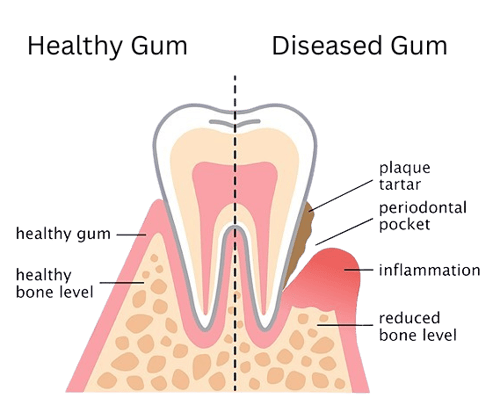 Image: Bone level around healthy vs diseased gums
To make an appointment at Sage Dental Specialists, please call or WhatsApp +6597365989.
Why try to save a natural tooth?
When a natural tooth can be predictably maintained, there are good reasons to keep it.
A natural tooth is connected to the surrounding bone by a thin layer of tissue called the periodontal ligament. This tissue helps the tooth sense pressure and absorb some of the forces generated during chewing.
A natural tooth also continues to support and stimulate the surrounding bone.
Perhaps most importantly, keeping a tooth preserves your options. If the tooth eventually needs to be replaced in the future, an implant may still be considered at that time.
However, saving a tooth at all costs is not always the right treatment.
A tooth that repeatedly develops infection, remains very mobile, cannot be kept clean, or continues to lose bone despite treatment may eventually cause more problems than it solves.
In these situations, removing the tooth and considering replacement may actually be the more conservative option — particularly if keeping a hopeless tooth results in further loss of the bone that could otherwise support a future implant.
What treatments can help?
Once the gum disease has been brought under control, different treatments may be considered depending on the condition of the tooth.
a) Non-surgical periodontal treatment
This involves carefully removing the bacterial deposits and hardened deposits that cause inflammation around the teeth.
As the inflammation improves, the gums can become healthier and the depth of the gum pockets can decrease. Teeth may also feel firmer.
Importantly, this does not mean that lost bone has grown back. Rather, the aim is to stop the disease from causing further damage.
For many patients, this combined with good daily oral hygiene and regular maintenance is all that is needed.
b) Regenerative periodontal surgery
In carefully selected cases, surgery can be used to regenerate the bone that has been lost.
Depending on the shape and location of the defect, bone grafting materials, membranes or other regenerative materials may be used to encourage the body to rebuild some of the lost supporting tissues.
Not every type of bone loss can be regenerated, which is why careful assessment is important.
c) Resective periodontal surgery
In some situations, trying to rebuild the lost bone is not the right option.
Instead, the goal may be to reshape the surrounding bone and gum tissue so that the area becomes easier to clean and maintain.
Although this approach may sound less appealing than “regeneration”, making an area easier to keep clean can sometimes provide a more predictable long-term result.
D) Managing tooth mobility and biting forces
Some teeth become mobile because of a combination of reduced bone support and excessive biting forces.
In selected cases, treatments such as splinting or adjusting the way the teeth come together can help reduce excessive movement and make the tooth more comfortable while the surrounding tissues recover.
What can treatment realistically achieve?
It is important to have realistic expectations.
Successful periodontal treatment does not usually return a tooth to exactly the same condition it was in before gum disease developed.
The goal is instead to achieve a tooth that is:
-
healthy and free from active infection;
-
stable and comfortable;
-
easier to keep clean;
-
able to function normally; and
-
maintainable over the long term.
A tooth can have less bone support than it originally had and still remain a perfectly functional tooth for many years.
That is a successful outcome, even if the original bone cannot be completely restored.
.png?width=640&height=853&name=presenting%20at%20(1).png)
Image: Dr Darrell Ong at Sage Dental Specialists
When is removing the tooth a preferred option?
Unfortunately, some teeth have reached a point where treatment is unlikely to provide a predictable long-term result.
Examples include teeth with very little remaining bone support, severe and persistent mobility, repeated infection, or areas that simply cannot be kept clean.
In these situations, removing the tooth may be the more sensible option.
This is not necessarily a failure of treatment. Sometimes removing a tooth earlier can help preserve the remaining bone and create better conditions for future tooth replacement, including a dental implant.
The important thing is to make this decision before investing significant time and money into treatment that is unlikely to succeed.
How do I find out if my tooth can be saved?
The only way to answer this properly is to assess the tooth in detail.
A periodontal assessment typically includes measurements around each tooth, an evaluation of tooth mobility and the surrounding gums, together with appropriate dental X-rays or 3D imaging when necessary.
This allows us to determine:
-
how much bone support remains;
-
where the bone has been lost;
-
whether there are areas that may be suitable for regeneration;
-
whether the tooth can be kept clean;
-
whether the gum disease is still active; and
-
what the long-term outlook is likely to be.
Importantly, prognosis is assessed for each individual tooth rather than simply labelling an entire mouth as “good” or “bad”.
You may have several teeth that are completely healthy, a few that require treatment, and perhaps one tooth that has a poor long-term outlook.
If you have been told that you have bone loss, or if one of your teeth has become loose, a detailed periodontal assessment can help determine whether the tooth is one that can be predictably maintained — and what options are available.
Frequently Asked Questions about Bone Loss Around Tooth
Q) Can bone loss around teeth be reversed?
Bone loss around teeth can sometimes be reversed, but not always.
Certain types of bone defects can be treated with regenerative periodontal surgery, allowing some of the lost supporting bone and tissues to be rebuilt.
However, not all patterns of bone loss are suitable for regeneration.
In every case, the first priority is to control the gum disease and prevent further bone loss. Even when lost bone cannot be rebuilt, stopping the disease from progressing is a very important treatment outcome.
Q) How much bone loss is too much to save a tooth?
There is no single percentage that automatically means a tooth must be removed.
The amount of remaining bone is important, but so are the shape of the bone defect, tooth mobility, the presence of inflammation, whether the area can be kept clean, and how the tooth responds to treatment.
This is why the long-term outlook is assessed for each tooth individually rather than based on a single measurement.
Q) Is it better to save a tooth or get a Dental implant?
If a natural tooth can be predictably treated and maintained, keeping it is generally preferable.
A natural tooth has a periodontal ligament and continues to function within its natural supporting tissues. It also does not develop peri-implantitis, the inflammatory disease that can affect the tissues around dental implants.
However, an implant may be the better option when a tooth has a poor long-term prognosis, cannot be kept clean, or would require repeated treatment while continuing to lose bone.
There is no universal answer. The optimal choice depends on the condition of the individual tooth and the patient's circumstances.
Q) Will my teeth get loose again after treatment?
Gum disease is a chronic condition that can be controlled but requires ongoing care.
After active treatment, maintaining healthy gums requires good daily oral hygiene and regular periodontal maintenance visits. The frequency of these visits depends on your individual risk.
With good maintenance and effective daily cleaning, many patients are able to keep their treated teeth healthy and functional for many years.
Reviewed by Dr Darrell Ong, BDS, MSc (Periodontics), FAMS, Registered Specialist in Periodontics, Singapore Dental Council.
To make an appointment at Sage Dental Specialists, please call or WhatsApp +6597365989.
Address: 435 Orchard Road, #12-04 Wisma Atria Office Tower, Singapore 238877
Questions about your gums or an implant? Contact Sage Dental Specialists