






01 — WELCOME
Come in. Let’s look at that tooth.
Every root canal here follows the same unhurried path. Follow one root canal journey — five scenes, from the front door to a saved tooth.
Wisma Atria, OrchardReferrals & direct appointments
Sage Dental Specialists · Wisma Atria, Orchard
Specialist endodontic care from Dr Elyssa Yap, a Singapore Dental Council-registered endodontist who treats root canals under the microscope.
Referred by your dentist?
It means your dentist wants a tooth that can be saved to be treated with specialist equipment and specialist hands. Dr Elyssa works alongside your dentist: she treats the root canal, and your dentist continues your ongoing care.
No referral? No problem. A referral letter is not required — direct appointments are welcome.
Referring a patient? Everything you need is on the for referring dentists page.
Symptom check
Eight quick questions — about a minute. This is not a diagnosis, but it will tell you whether what you are feeling matches the signs endodontists treat, and what a sensible next step looks like.
What your answers can mean
Facial or jaw swelling deserves same-day attention — call us today. Go to A&E now if you also have fever, difficulty swallowing or breathing, trouble opening your mouth, or the swelling is spreading towards your eye or neck.
In a lot of pain? Call us rather than message — calling is the fastest way to arrange the earliest appointment, and an acutely painful tooth can be settled with emergency pain relief while treatment is planned.
If your dentist has referred you:
A referral letter means a dentist has examined the tooth and concluded it needs specialist root canal care. The next step is simple: send us the referral letter and any X-rays by WhatsApp, and we can prepare an itemised quotation before you visit.
In pain now, or is your face starting to swell? Call us today rather than waiting for the quotation.
If a root-treated tooth is acting up again:
A root-treated tooth has no live nerve, so new pain, tenderness or a spot on the gum near it usually means the old root filling is leaking or infection has returned. That does not settle by itself — but it is routine work for an endodontist: many of these teeth can be retreated or repaired with minor surgery, and an examination with X-rays will show what is going on.
If your face or jaw is swelling, call us today rather than waiting. Otherwise, send us what you remember of the original treatment — even the year and the clinic helps — and we will take it from there.
If one or more of the strong signs applies — pain lingering after hot or cold, unprovoked or night-time aching, sharp pain on biting or on release, a recurring gum spot, a darkened tooth:
Your symptoms may be suggestive of dental nerve inflammation or infection. These symptoms rarely settle on their own. Our endodontist aims to accurately diagnose the problem, relieve pain, treat infection, and preserve the natural tooth whenever possible.
Treatment options may range from vital pulp therapy / filling, tooth splint, root canal treatment, root canal retreatment or surgical endodontics.
Only a clinical examination and appropriate X-rays can confirm what is happening. The earlier a tooth is assessed, the more options there may be for preserving and saving it.
If a few milder signs apply — tenderness, brief sensitivity, a history of deep fillings or an old injury:
Some of your answers suggest something worth checking — often the nerve, sometimes the gum around the tooth. Caught at this stage, the cause — decay, a leaking filling, a crack — can often be treated before the nerve is damaged beyond recovery. Left alone, the same picture can progress to the lingering, unprovoked pain of a root canal problem.
A short examination with an X-ray will usually tell us what is going on. You can start with your regular dentist, or come straight to us — a referral is not required.
If none of the signs apply:
Your answers don’t include the classic signs of nerve trouble, so a routine check-up with your regular dentist is the sensible next step.
One exception: a tooth that has cracked, chipped or broken should be repaired within a few days even if it doesn’t hurt — an unprotected crack is how nerves get into trouble.
Keep an eye on the signs that change the picture: pain that lingers after hot or cold, aching that starts by itself or wakes you at night, sharp pain on biting, a pimple-like spot on the gum, or a tooth turning darker. If any of these appear, that’s the moment to have it assessed.
Questions about a tooth anyway? WhatsApp us — we’re happy to help.
This symptom check is general information to help you decide on a next step — it isn’t a diagnosis, and it can’t replace an examination and an X-ray. If you are in severe pain, seek care the same day. If swelling is spreading, or you have fever or any difficulty swallowing or breathing, go to A&E now.
.png?width=500&name=website%20new%20member%20-%20USE%20THIS%20(8).png)
Your specialist · Singapore Dental Council
Endodontist — a dentist with postgraduate specialist training devoted to saving teeth through root canal treatment, retreatment and endodontic surgery.
Dr Elyssa holds both her Bachelor and Master of Dental Surgery from the National University of Singapore (NUS), and has published research on the management of cracked teeth. She spent more than ten years in the public sector, including as Associate Consultant at the National Dental Centre Singapore, where she still serves as a Visiting Specialist, and has received multiple awards for excellence in patient care and mentorship. She takes the time to listen, explain and reassure, which is most of what makes root canal treatment comfortable. Read Dr Elyssa’s full profile.
The equipment
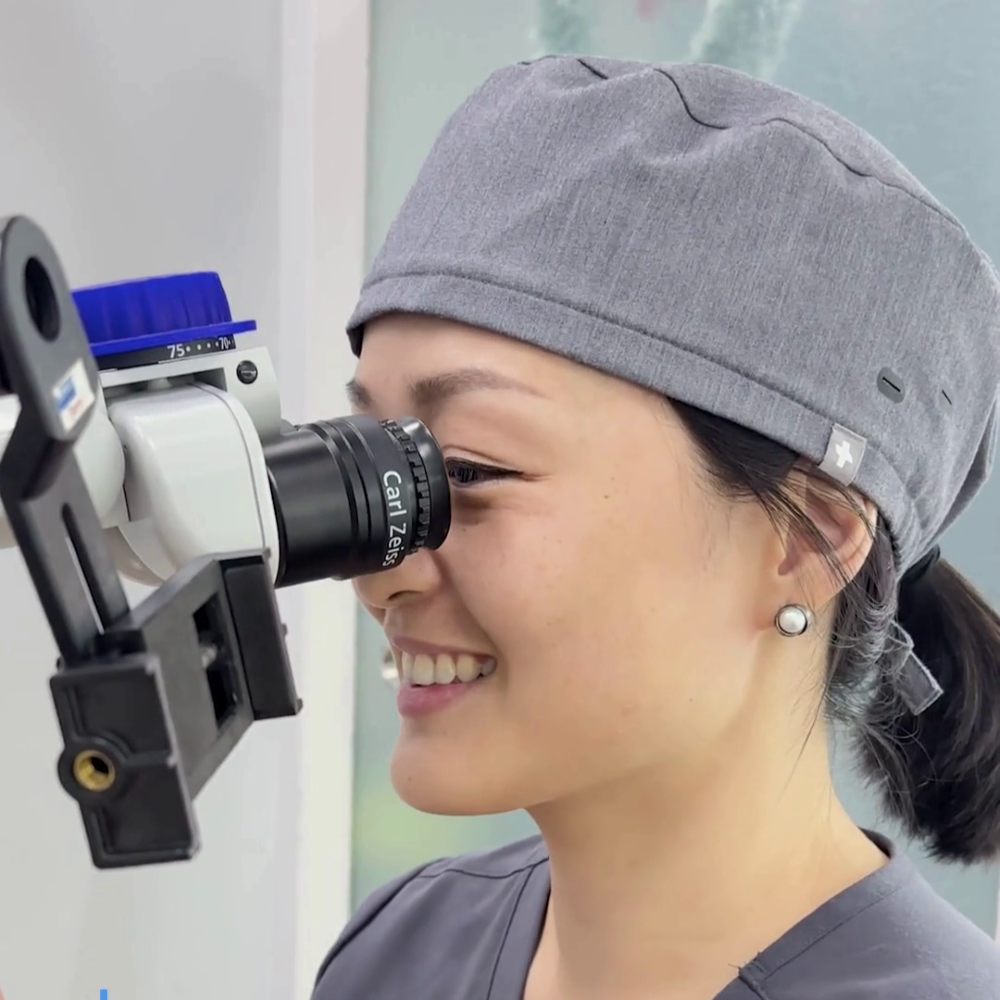
Technology · 01
Root canals are measured in fractions of a millimetre. The dental operating microscope magnifies the tooth up to 20 times, so hidden canals can be found, cracks can be seen, and infected tissue can be removed with precision that the naked eye cannot match.

magnification with the dental operating microscope
Technology · 02
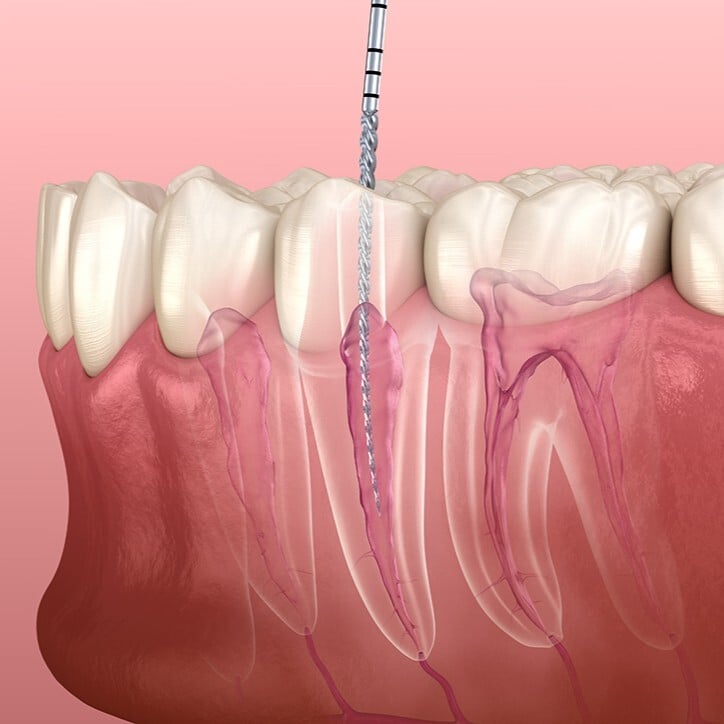
Engine-driven nickel-titanium instruments shape the canal smoothly and efficiently, following its natural curve. That means more of your healthy tooth structure is preserved, and treatment time in the chair is shorter.

flexible nickel-titanium files follow the canal's natural curve
Technology · 03
After the canal is shaped, laser-activated irrigation helps drive the disinfecting solution into the fine branches and side canals that instruments cannot reach — a deeper clean of the spaces where bacteria persist.
activated irrigation reaches where instruments cannot
Technology · 04
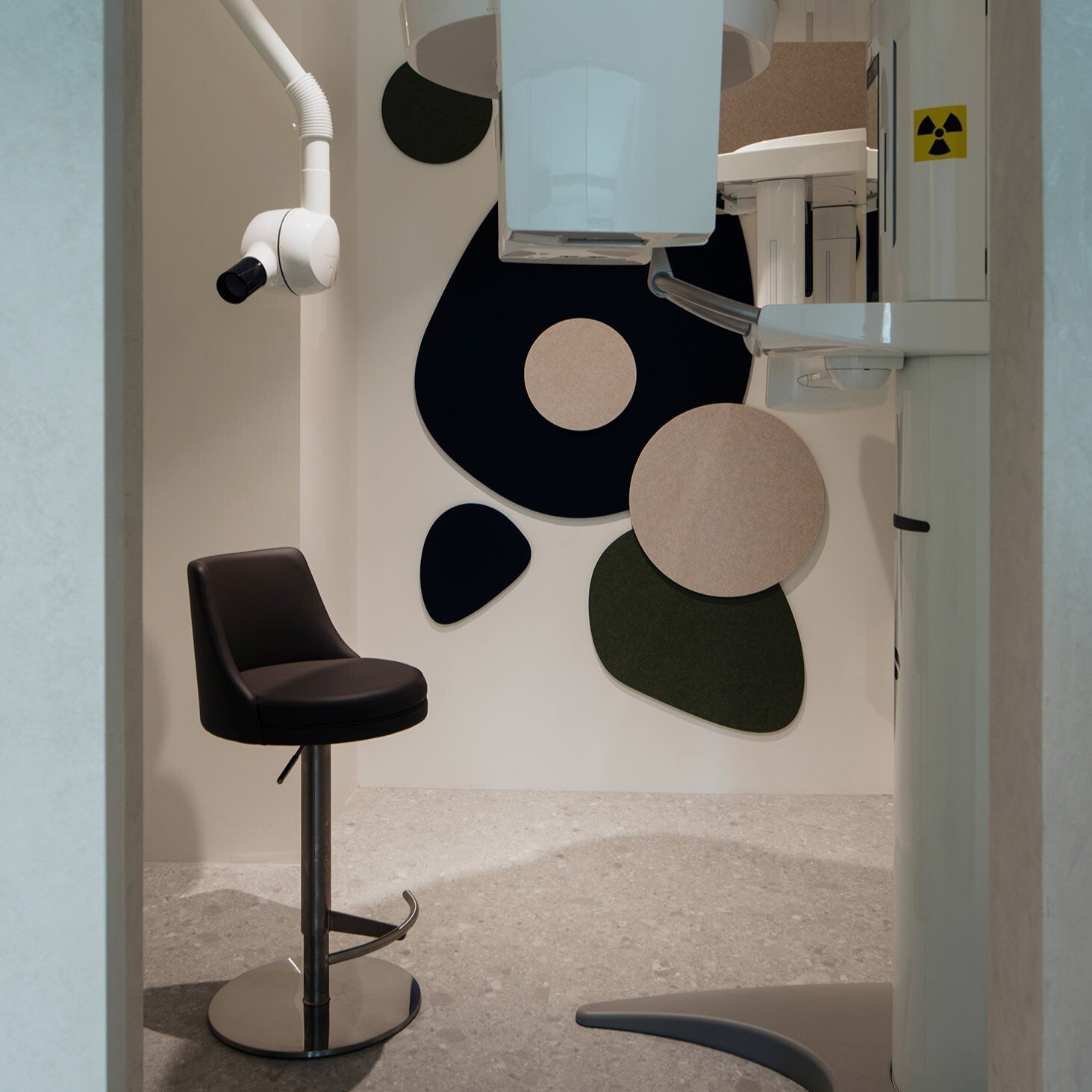
Digital X-rays at a fraction of the radiation of conventional film guide each stage of treatment — confirming canal lengths, checking the fill, and documenting healing at review.

low-dose imaging at every stage of treatment
Swipe to explore
What to expect · A day in the practice
No mystery, no surprises — swipe or scroll through one visit, from welcome to tooth saved.


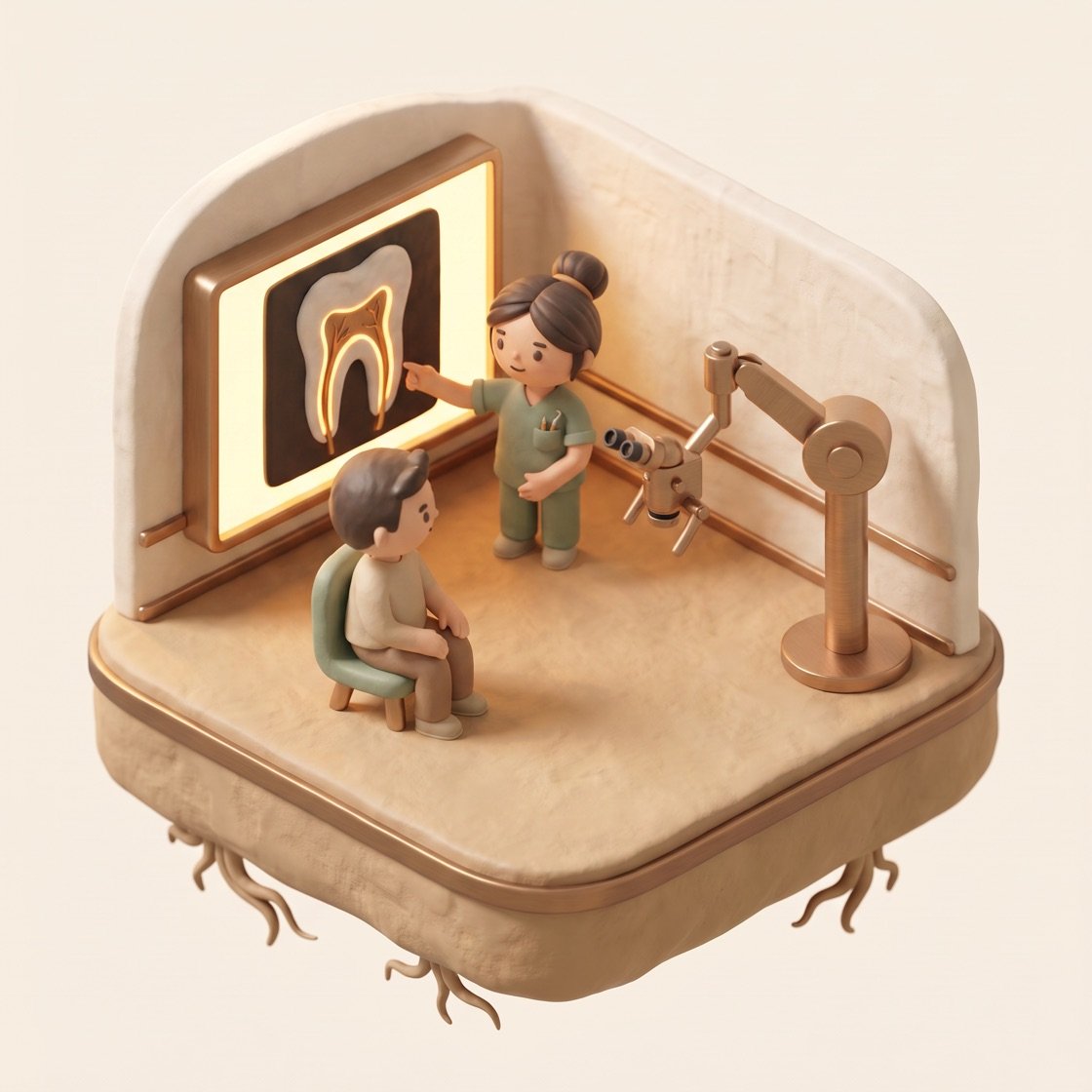
Every root canal here follows the same unhurried path. Follow one root canal journey — five scenes, from the front door to a saved tooth.
What hurts, when it started, what you have been told — the tooth that hurts is not always the tooth at fault, so it begins by listening. Then examination, imaging and the tests needed to confirm what is going on, with an itemised fee breakdown before anything begins.
One tooth becomes a map: how many canals, how curved, how far infection has travelled. Dr Elyssa talks you through the findings before anything is decided.
Under local anaesthesia and the microscope, the infected pulp is removed and the canals are cleaned, shaped and disinfected — an unhurried pace, each step explained first. The cleaned canals are then filled and sealed to prevent reinfection; many cases finish in one to two visits.
Your referring dentist places the final restoration — usually a crown — and carries on your care, with a review to confirm the tooth is healing well. Nothing replaces your own tooth: keeping it is the whole job.
Not every tooth can be saved — prognosis depends on the individual tooth. Dr Elyssa gives you an honest assessment at consultation, including when extraction is the better option.
Swipe or scroll
That is the whole path, start to finish.If your tooth needs it, the next step is a specialist consultation at Wisma Atria, Orchard.
From our clinicians
Short explainers recorded by our own clinicians — including Dr Elyssa — answering the questions patients actually ask.
The clinic
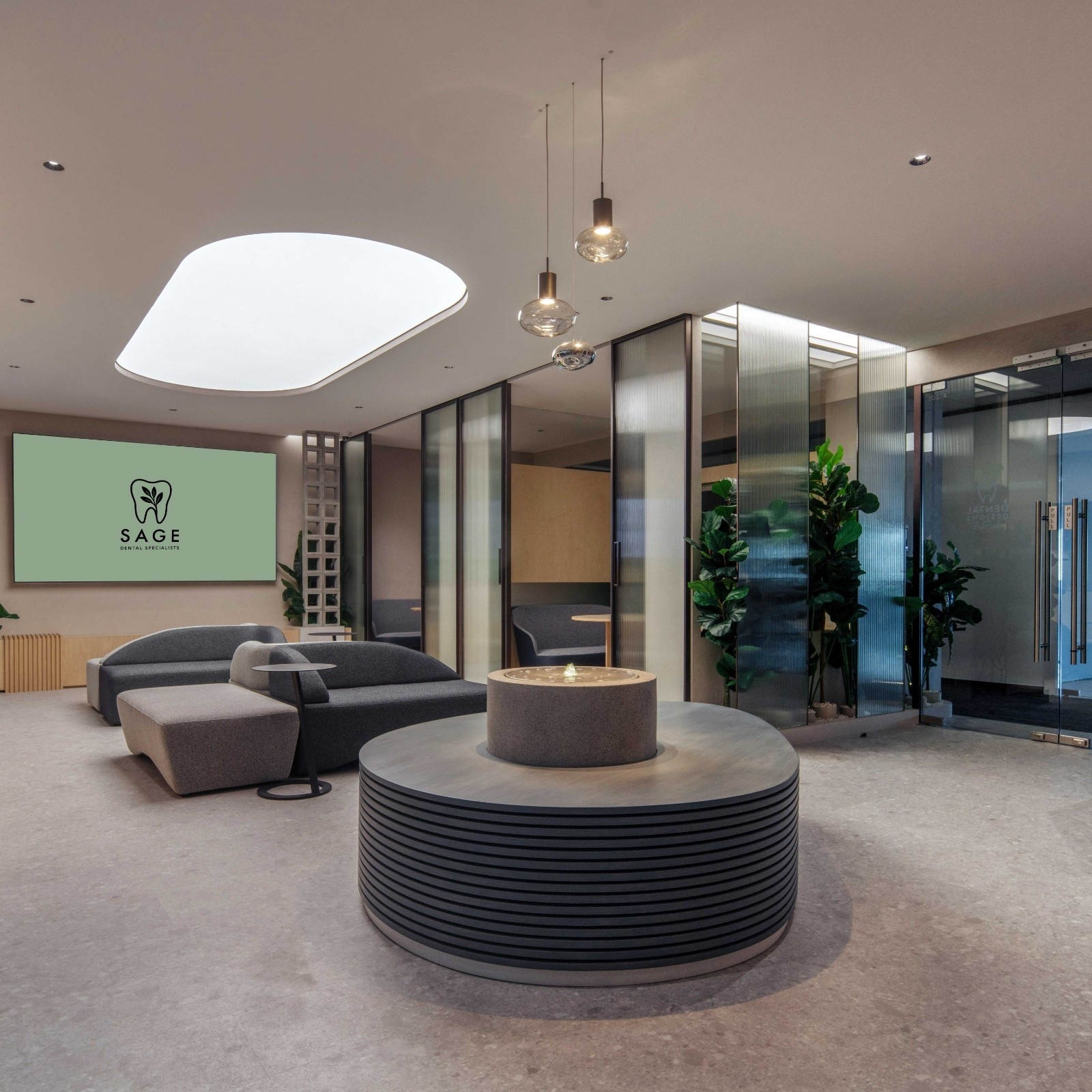
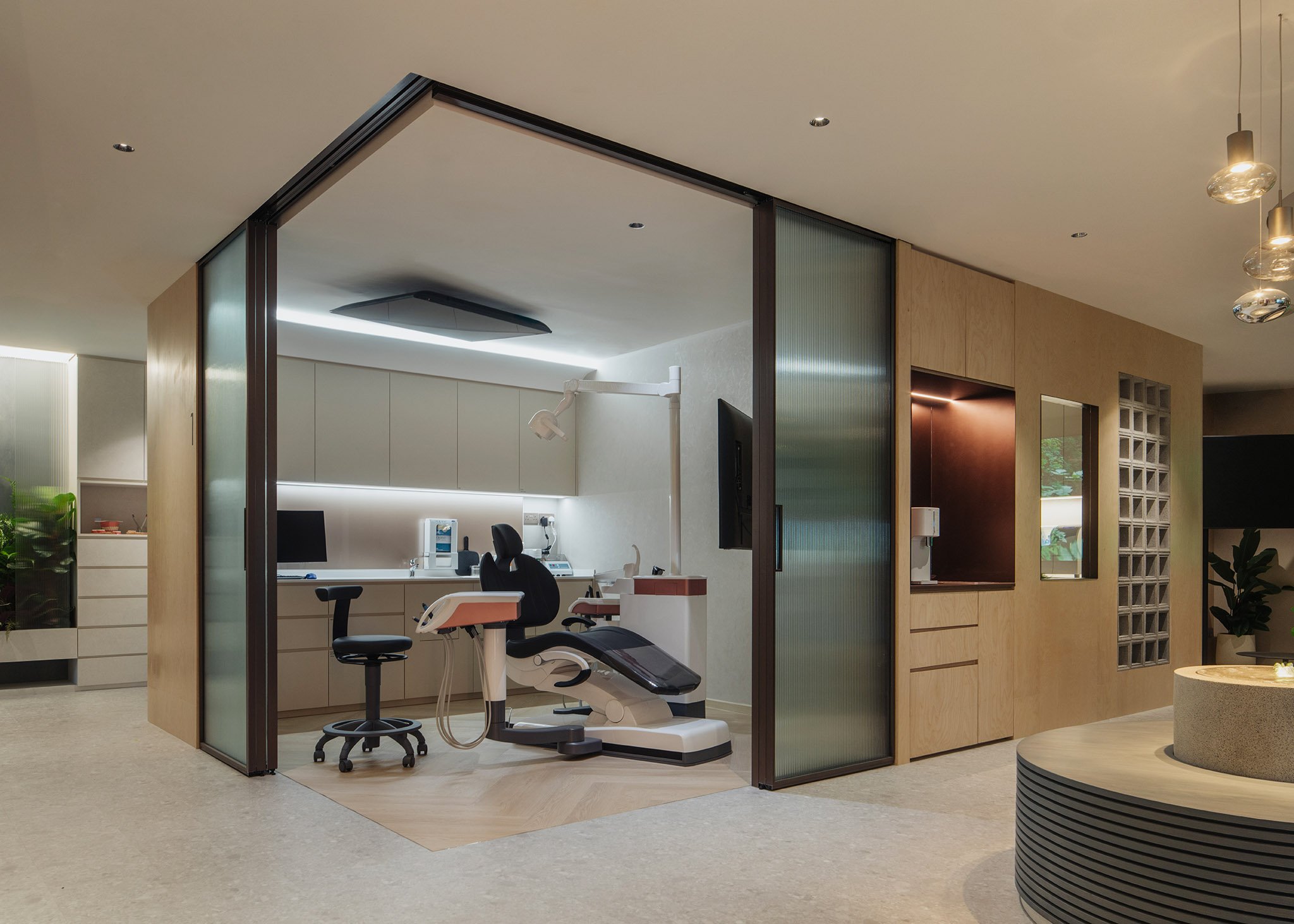
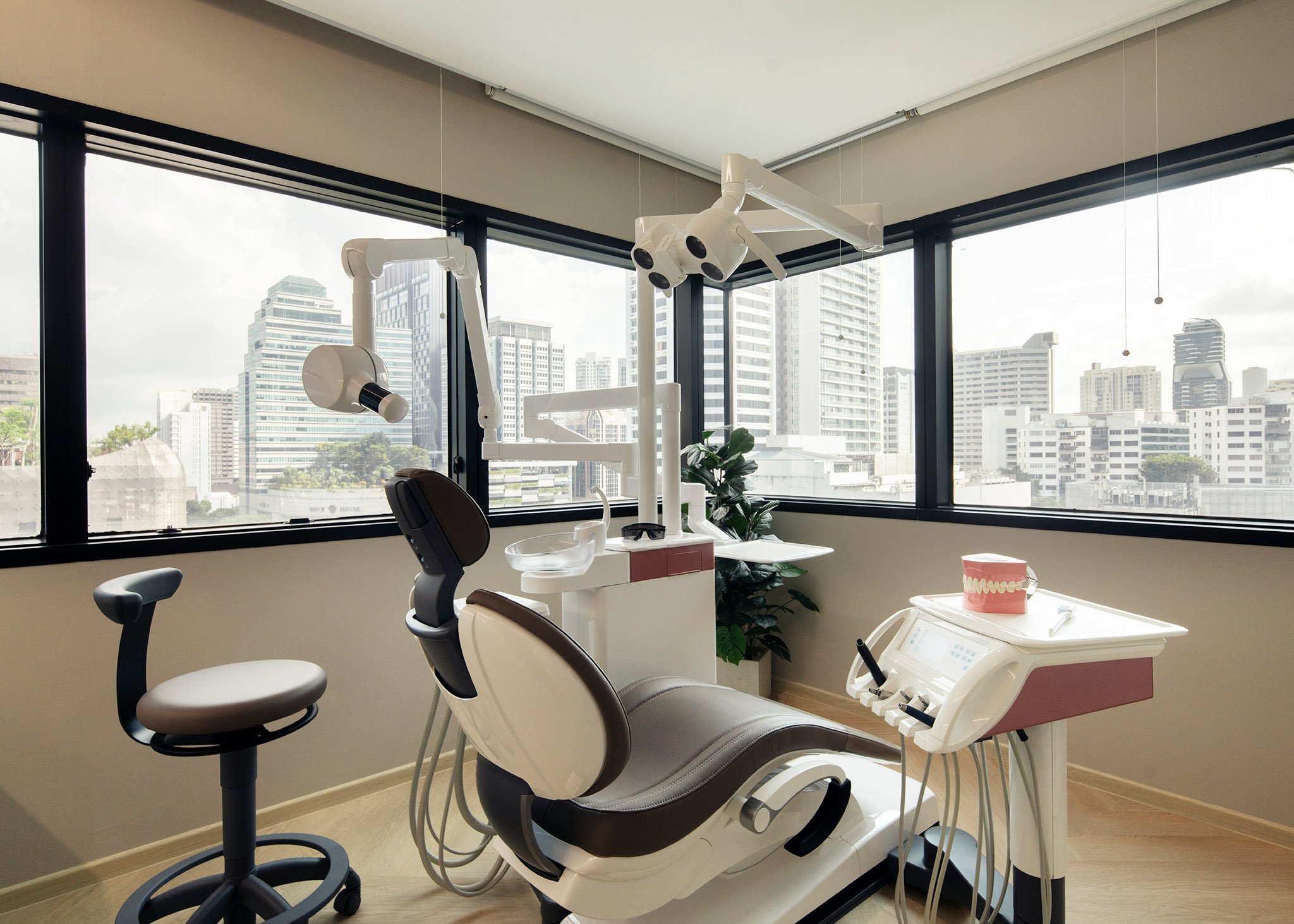
A specialist clinic on the 12th floor of Wisma Atria — quiet, unhurried, and equipped for one purpose: careful endodontic work.


Questions
The classic signs are pain that lingers for 30 seconds or more after hot or cold, aching that starts on its own or wakes you at night, sharp pain on biting or on releasing a bite, a pimple-like spot on the gum that comes and goes, and a tooth turning grey or darker than its neighbours. Any one of these is a reason to have the tooth examined — the symptom check on this page walks you through them in about a minute, and only an examination and an X-ray can confirm what is happening.
An endodontist is a dentist with additional specialist training in treating the inside of the tooth — the pulp and root canals. A referral usually means your tooth needs care that benefits from specialist equipment and experience: a complex canal shape, a retreatment, or a tooth that is difficult to diagnose. Your general dentist continues to look after your overall dental care.
Dr Elyssa reviews your referral notes and X-rays, examines the tooth, and carries out the tests needed to confirm the diagnosis. You will receive a clear explanation of the findings, the options available, and an itemised breakdown of fees before any treatment begins. Where appropriate, treatment can begin at the same visit.
A root canal appointment at Sage Dental Specialists typically takes 60 to 90 minutes, and most teeth are completed in one to two visits. Working under the microscope is precise, unhurried work — the time is spent locating, cleaning and sealing the canals properly. You can return to work or normal activities the same day; just wait until the numbness has worn off before eating.
Many root canal treatments are completed in one to two visits, depending on the complexity of the tooth and whether infection is present. Dr Elyssa will give you a clear plan at the first appointment, including how many visits to expect and what happens at each one.
Yes. An acutely painful tooth can usually be settled with emergency treatment — a pulpectomy, which removes the inflamed pulp and relieves the pressure that causes the pain. Call or WhatsApp us, describe what you are feeling, and the team will fit you in as early as possible. Emergency pain relief is listed in our fee guide at $436 to $599.50, inclusive of 9% GST, so you know the cost before you arrive. If root canal treatment is commenced on the same visit, the emergency fee is waived.
The treatment is carried out under local anaesthesia, and keeping discomfort to a minimum is a central part of how the clinic works — modern anaesthesia techniques, a gentle pace, and a specialist who explains each step before it happens. Many patients are surprised that the visit feels similar to having a filling done. Some tenderness after treatment is normal and usually settles within a few days.
Some tenderness for a few days after a root canal is normal — the tissues around the root need time to settle, and simple painkillers are usually enough. Pain that persists beyond a week, gets worse, or returns months later has a cause worth finding: often a bite that sits slightly high on the new filling (a quick adjustment), sometimes inflammation still settling in the bone, and less often infection remaining in a canal. If a treated tooth is still troubling you, have it reviewed — an examination and X-ray can usually show what is happening.
Usually, no. Antibiotics cannot resolve an infection inside a tooth — the infected pulp has lost its blood supply, so the drug has no way to reach the source. Cleaning the canals is what actually treats it. Antibiotics have a specific supporting role, reserved for signs the infection is spreading beyond the tooth: facial swelling, fever, or feeling unwell. Taking them without treating the tooth postpones the problem and contributes to antibiotic resistance.
A small pimple on the gum near a tooth is often a sinus tract — a drainage channel from a chronic infection at the tip of the root. It may swell, drain and reappear, and because the drainage keeps releasing the pressure, it often does not hurt — which makes it easy to ignore. It should not be ignored: the infection it drains does not resolve on its own. It is one of the clearest signs that a tooth needs endodontic assessment, and an X-ray usually confirms which tooth is the source.
An infected pulp does not heal on its own, so waiting does not make root canal treatment unnecessary — it changes how much is left to save. The tooth may stay quiet for months and then flare without warning, infection can spread into the surrounding bone, and a weakened tooth can crack in a way that makes it unrestorable. If treatment genuinely has to wait, tell us: the tooth can be assessed, the risks explained honestly, and sensible interim steps planned.
Where a tooth can be restored, keeping it is generally the better long-term outcome — nothing replaces a natural root. Root canal treatment preserves your own tooth, bite and bone. Extraction leaves a gap that usually needs an implant, bridge or denture, which over time typically costs more than the root canal and crown. Some teeth, though, genuinely are better removed — too little sound structure left, or an untreatable crack. Part of a specialist's role is telling you honestly which side of that line your tooth is on, before any treatment starts.
Yes — a small proportion of root canal treated teeth develop problems years later. The usual causes are new decay or a leaking filling or crown letting bacteria back in; occasionally it is canal anatomy that could not be found at the first treatment. This is not the end of the tooth: retreatment under the microscope, or endodontic surgery, can resolve many of these. What protects a treated tooth is a well-sealed restoration placed soon after treatment, and regular check-ups with your dentist.
Most root canal treated teeth need a restoration — often a crown — to protect them long-term. Dr Elyssa coordinates with your referring dentist, who usually places the final restoration and continues your ongoing care. A review appointment checks that healing is progressing as expected.
At Sage Dental Specialists, root canal treatment starts from $872 for an incisor, canine or premolar and from $1,308 for a molar. Retreating a tooth that has had root canal treatment before ranges from $1,417 to $2,398, and rebuilding the tooth afterwards starts from $228.90. The specialist consultation is from $98, or from $163.50 for a complex assessment. All figures are inclusive of 9% GST. Fees vary with the complexity of the tooth and the time treatment takes, so you receive an itemised quotation for your specific tooth before any treatment begins.
Most of the fee is specialist time under a microscope. A root canal involves 60 to 90 minutes per visit of precise work locating, cleaning, shaping and sealing canals that can be a fraction of a millimetre wide, using equipment built for exactly this — an operating microscope, rotary instrumentation, protective isolation. It is also worth setting against the alternative: extracting the tooth and replacing it with an implant or bridge typically costs more over time than the root canal and crown. Our fee guide is published in full above, and every quotation is itemised before treatment begins.
Routine, non-surgical root canal treatment is not claimable under Medisave. Endodontic surgery is. Periradicular surgery on a single-rooted tooth (code SF708T) is claimable up to $1,620; on a multi-rooted tooth, or where more than one tooth is treated (SF818T), up to $1,890; reimplantation or transplantation following dislocation of a tooth (SF814T) up to $1,890; and exploratory surgery (SF703M) up to $740. These limits combine the surgical procedure limit and the day-surgery fee; GST is not claimable under Medisave. Eligible patients may also use Flexi-MediSave for up to $400 a year towards outpatient treatment. We check your eligibility and confirm the exact claimable amount with you before treatment begins.
We work with a range of dental insurers and corporate benefit schemes, and how each plan is handled depends on the insurer and the plan itself. Send us your benefit card or policy details and the team will check your coverage before your visit. CHAS and Medisave details are on our payments and insurance page.
Yes — root canal treatment can be carried out safely during pregnancy, and treating a dental infection is generally safer than leaving it. The second trimester is usually the most comfortable time; local anaesthesia is considered safe in pregnancy, and modern digital X-rays use very low doses, taken only when needed and directed well away from the abdomen. Tell the team you are pregnant, or think you may be, and how far along you are — the appointment is planned around it.
Sometimes. A young adult tooth — most often a front tooth after a knock, or a molar with deep decay — can need root canal treatment, and treating it matters because that tooth has decades of service ahead. Adult teeth whose roots have not finished forming need particular specialist techniques. Baby teeth are different: they are usually managed by your child's dentist with their own pulp treatments rather than a conventional root canal.
Still have a question?Ask us directly — the team can answer before you book, and Dr Elyssa answers the clinical ones.
Fees
You should not have to ask what this will cost. Here is the guide we work from, published in full. Your own quotation is itemised line by line at the consultation — and if you send your referral letter and X-rays by WhatsApp beforehand, we can prepare it before you visit.
Examination, tests and diagnosis with the endodontist.
Periapical radiographs are the common imaging for root canal treatment; in certain situations a panoramic radiograph or 3D scan may be indicated.
Non-surgical, priced by the tooth.
Reopening and re-treating a tooth that has had root canal treatment before.
A pulpectomy to settle an acutely painful tooth. The fee is waived if root canal treatment is commenced on the same visit.
All figures in Singapore dollars, inclusive of 9% GST. From-prices are starting points: fees rise with the complexity of the tooth and the time treatment takes, and your quotation is specific to your tooth, itemised before treatment begins.
Routine root canal treatment is not Medisave-claimable. Endodontic surgery is — and if surgery is what saves your tooth, the claimable amounts are substantial.
These are the total Medisave-claimable limits for each procedure code — the surgical procedure limit plus the day-surgery fee — not the fee itself. Medisave claims cannot include GST; the GST portion of your bill is payable by the patient. We check your eligibility and confirm the exact claimable amount with you before treatment begins — you will never find out afterwards.
CHAS, Medisave and dental insurance — everything on one page, so you can check what applies before you visit.
Want a quotation for your own tooth?Send your referral letter and any X-rays and we can itemise it before you visit.
Read more
Plain answers written at the clinic and reviewed by Dr Elyssa Yap, for the questions that come up before a first visit.
Sage Dental Specialists
435 Orchard Road, #12-04 Wisma Atria Office Tower, Singapore 238877
Above Orchard MRT (NS22 / TE14) via Exit 3 · parking in the same building
Monday to Friday 9am – 6pm · Saturday 9am – 1pm · closed Sundays and public holidays
Referring dentist? Visit our referring dentists page.